
Any links on this page that lead to products on Amazon, the Ebay Partner Network (EPN) and other companies may be affiliate links and we earn a commission if you make a qualifying purchase. Thanks in advance for your support!
Remote control planes for adults – If you’re looking to step up your RC aircraft game in 2026, you want a plane that matches your skill and goals and embodies a degree of challenge for adult flyers beyond that offered by kids’ planes. We’ll walk you through five top choices—from trainers that build confidence to high-performance models for photo flights—so you can pick the right fit and get back to flying with confidence.
Key Takeaways
- Choose RTF VolantexRC 4-channel models for advanced control and durable foam construction suitable for aerobatics and progression.
- Opt for the P51D Mustang RTF for warbird handling, gyro stabilization, and up to 20-minute flights with strong 2.4GHz range.
- Select the Sport Cub 4CH or Trainer 3CH for progressive flight-assist modes and 6-axis gyros ideal for adult beginners.
- Pick the Ranger 1600 PNP glider when seeking large-span stability, FPV compatibility, and brushless power for aerial photography.
- Prioritize models with quality foam/unibody builds, strong anti-interference radios, and accessible mounts for cameras and upgrades.
| VolantexRC 4-Channel Remote Control RC Airplane RTF |  | Best for Progression | Control Channels: 4-channel | Ready/Assembly State: RTF (Ready to Fly) | Flight Assistance / Stability System: Three flight modes (beginner → expert) | VIEW LATEST AMAZON PRICE | Read Our Analysis |
| VOLANTEXRC P51D Mustang RC Airplane (RTF) |  | Aerobatics Powerhouse | Control Channels: 4-channel | Ready/Assembly State: RTF (Ready to Fly) | Flight Assistance / Stability System: Three flight control assistance levels + Xpilot gyro stabilizer | VIEW LATEST AMAZON PRICE | Read Our Analysis |
| VOLANTEXRC Sport Cub 4CH RC Trainer Plane (Red) |  | Beginner-Friendly Trainer | Control Channels: 4-channel | Ready/Assembly State: RTF (Ready to Fly) | Flight Assistance / Stability System: Three flight control assistance levels + 6-axis gyro | VIEW LATEST AMAZON PRICE | Read Our Analysis |
| VolantexRC Ranger 1600 PNP RC Glider Airplane | 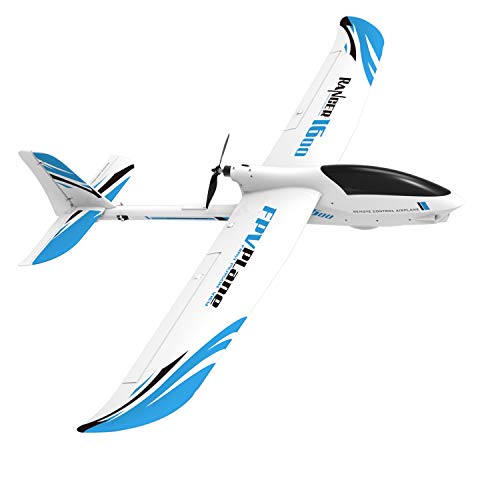 | FPV & Endurance Glider | Control Channels: PNP with servos (4 servos included) — multi-channel glider (servos for throttle/aileron/elevator/rudder) | Ready/Assembly State: PNP (Plug-N-Play; requires transmitter/receiver/battery/charger) | Flight Assistance / Stability System: Large-span stable glider design (passive stability); servos included (no flight-assist electronics specified) | VIEW LATEST AMAZON PRICE | Read Our Analysis |
| VOLANTEXRC Trainer RC Plane 3CH with Gyro (400mm) | 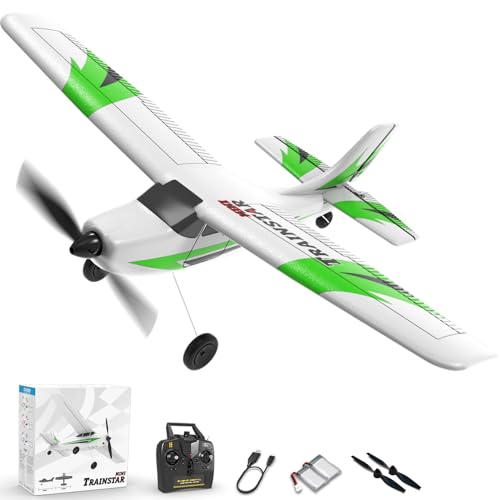 | Long-Flight Stability | Control Channels: 3-channel | Ready/Assembly State: RTF (Ready to Fly) | Flight Assistance / Stability System: 3 flight modes + Xpilot/6-axis gyro stabilizer | VIEW LATEST AMAZON PRICE | Read Our Analysis |
More Details on Our Top Picks
VolantexRC 4-Channel Remote Control RC Airplane RTF
The VolantexRC 4-Channel RTF is ideal for adult hobbyists seeking a step up from beginner models, offering precise four-channel control for ascents, descents, turns, and basic aerobatics. Constructed from high-quality foam, the 23.6 by 18.1 inch RTF model balances stability and impact resistance while a propeller protection system reduces damage during rough landings. Three flight modes accommodate novices through professionals, enabling progressive skill development. The ready-to-fly package includes three extra airplane batteries, three spare propellers (one pre-installed), a five-port charger, and four AA batteries for the transmitter, supporting extended sessions and minimal setup time.
- Control Channels:4-channel
- Ready/Assembly State:RTF (Ready to Fly)
- Flight Assistance / Stability System:Three flight modes (beginner → expert)
- Intended User / Skill Level:Adults; beginners to professionals
- Radio System / Range (2.4GHz):2.4GHz remote (advanced 4-channel) — implied standard RC radios
- Aerobatic Capability / Thrust System:Capable of aerobatics; advanced motor/prop system; prop protection
- Additional Feature:Three spare batteries included
- Additional Feature:Five-port charger included
- Additional Feature:Propeller protection system
VOLANTEXRC P51D Mustang RC Airplane (RTF)
Ideal for pilots who want an accessible yet capable warbird, the VOLANTEXRC P51D Mustang RTF pairs a powerful motor-gear system and Xpilot gyro stabilizer with three selectable assistance levels so both beginners and experienced flyers can enjoy stable, responsive flight. The ready-to-fly model launches in under a minute and needs only transmitter batteries. A 2.4GHz control system with anti-interference and a 656-foot range supports outdoor flights and club events. Strong gearbox thrust enables aerobatics via a single button and up to 20 minutes of continuous flight; the model can even hold position briefly. Compact design eases transport and field setup.
- Control Channels:4-channel
- Ready/Assembly State:RTF (Ready to Fly)
- Flight Assistance / Stability System:Three flight control assistance levels + Xpilot gyro stabilizer
- Intended User / Skill Level:Beginners to experts; adults
- Radio System / Range (2.4GHz):2.4GHz remote; range ~656 ft
- Aerobatic Capability / Thrust System:Aerobatics with button; powerful motor-gear and gearbox thrust system
- Additional Feature:Xpilot gyro stabilizer
- Additional Feature:Gearbox motor system
- Additional Feature:20-minute continuous flight
VOLANTEXRC Sport Cub 4CH RC Trainer Plane (Red)
For adults learning to fly, the VOLANTEXRC Sport Cub 4CH stands out for its three-tier flight-assist system that lets beginners progress from full stabilization to manual control. The ready-to-fly red trainer measures 500mm and pairs a powerful motor-gear thrust trainer gearbox with a 6-axis gyro stabilizer for stable, responsive handling. Pilots can take off and hover via a button and left-stick hold, or trigger a dedicated aerobatics button. A 2.4GHz transmitter provides about 656 feet of range and solid anti-interference performance. Continuous flight reaches roughly 20 minutes per charge; only transmitter batteries are required to start flying.
- Control Channels:4-channel
- Ready/Assembly State:RTF (Ready to Fly)
- Flight Assistance / Stability System:Three flight control assistance levels + 6-axis gyro
- Intended User / Skill Level:Beginners and adults (trainer)
- Radio System / Range (2.4GHz):2.4GHz remote; range ~656 ft
- Aerobatic Capability / Thrust System:Aerobatics with button; motor-gear and thrust trainer gearbox
- Additional Feature:6-axis gyro stabilizer
- Additional Feature:500mm compact size
- Additional Feature:Takeoff/hover button
VolantexRC Ranger 1600 PNP RC Glider Airplane
Boasting a 1600mm wingspan and a lightweight unibody plastic fuselage, the VolantexRC Ranger 1600 PNP suits adults seeking a stable, easy-to-assemble glider that doubles as an FPV platform. The 1100mm fuselage and 1050g flying weight balance glide performance and portability. It ships with four 9g servos, a BL2212/1400KV brushless motor, and a 30A ESC; transmitter, receiver, battery, and charger are excluded. The clip-on wing system simplifies setup and storage while the flexible fuselage absorbs impacts. Large wings enhance in-flight stability. Multiple camera mounts, including a pre-cut hole and flat bed, accommodate varied FPV setups for aerial photography and video.
- Control Channels:PNP with servos (4 servos included) — multi-channel glider (servos for throttle/aileron/elevator/rudder)
- Ready/Assembly State:PNP (Plug-N-Play; requires transmitter/receiver/battery/charger)
- Flight Assistance / Stability System:Large-span stable glider design (passive stability); servos included (no flight-assist electronics specified)
- Intended User / Skill Level:Adults; suitable for beginners and experienced pilots
- Radio System / Range (2.4GHz):(Requires user radio) compatible with standard transmitter/receiver (2.4GHz typical)
- Aerobatic Capability / Thrust System:Brushless BL2212/1400KV motor + 30A ESC (good thrust for glider/FPV use) — not focused on aerobatic button but capable with motor/controls
- Additional Feature:1600mm wingspan
- Additional Feature:Unibody plastic fuselage
- Additional Feature:Multiple camera mounts
VOLANTEXRC Trainer RC Plane 3CH with Gyro (400mm)
The VOLANTEXRC Trainer RC Plane 3CH with Gyro (400mm) is a solid pick for adult beginners who want a stable, confidence-building aircraft; its 6-axis Xpilot gyro stabilizer and three selectable flight modes deliver progressive assistance from full beginner help to manual expert control. This ready-to-fly, green 400mm trainer arrives fully assembled and portable, needing only battery installation. A prop saver and gearbox-enhanced motor provide reliable thrust for basic aerobatics and efficient cruising, supporting up to 30 minutes per charge. With a 2.4GHz radio range of about 656 ft and strong anti-interference, it suits outdoor practice and small club flights.
- Control Channels:3-channel
- Ready/Assembly State:RTF (Ready to Fly)
- Flight Assistance / Stability System:3 flight modes + Xpilot/6-axis gyro stabilizer
- Intended User / Skill Level:Beginners; adults (trainer)
- Radio System / Range (2.4GHz):2.4GHz remote; range ~656 ft
- Aerobatic Capability / Thrust System:Powerful motor system, gearbox for thrust; suitable for aerobatic flying
- Additional Feature:Prop saver included
- Additional Feature:6-axis Xpilot gyro
- Additional Feature:Up to 30 minutes flight
Factors to Consider When Choosing Remote Control Planes for Adults
When choosing an RC plane, think about what you want to do—training, aerobatics, or long-range cruising—and pick a model that matches that purpose. Match the plane to your skill level and look for stability systems like gyros or self-leveling if you’re still learning. Also check motor power and battery life for endurance, and confirm the control range and frequency are suitable for your flying environment.
Aircraft Purpose
Purpose drives the choice of a remote control plane, so decide whether you want relaxed cruising, aerobatic tricks, or high-speed racing before you shop. Pick a model that matches your intended use: gliders and stable trainers for leisurely flights, nimble aerobatic planes for stunts, or lightweight, powerful racers for speed.
Match the aircraft size and power to your flying environment — open fields allow larger, faster models; indoor spaces need smaller, low-speed designs.
If you plan aerial photography, choose camera-compatible airframes and payload capacity.
Consider expected flight duration and battery efficiency; longer flights mean better batteries and efficient motors. These purpose-driven choices narrow options quickly and guarantee you get a plane suited to how you’ll actually fly.
Skill Level Match
Having picked the kind of flying you want, next match the plane to your skill level so you don’t end up frustrated or grounded. Choose models with multiple assistance levels—beginner, intermediate, and expert—so you can progress without buying a new plane.
If you’re new, look for ready-to-fly (RTF) options with simplified setup and features like gyro stabilizers that make handling forgiving. As you gain confidence, move to intermediate modes or customizable kits that let you tweak controls and try basic aerobatics.
Advanced pilots should pick planes that offer full manual control and true aerobatic capability to refine techniques. Always assess control complexity and available modes before buying to verify the aircraft fits your current skills and growth plans.
Flight Stability Systems
Because stability systems do the heavy lifting in gusty or technical conditions, you’ll want to prioritize planes with reliable gyro stabilizers and selectable assistance modes so you can fly confidently as you learn and progress. These systems boost control and make handling easier, especially if you’re a beginner moving toward intermediate skills.
Pick models offering multiple assistance levels so you can dial back aid as you improve. Advanced stabilizers smooth out wind and turbulence, lowering crash risk and making maneuvers more predictable.
Some planes add propeller protection to safeguard motors and maintain stability during landings or accidental strikes. Effective stability features also improve overall performance and can extend usable flight time, letting you enjoy longer, more satisfying sessions without constant corrections.
Power And Endurance
Stability systems make flying feel easier, but you’ll still need the right power and endurance to get the most out of your sessions. Check motor-gear systems first: they dictate thrust and efficiency, letting you do sharper maneuvers and sustain speed without wasting battery. A robust gearbox boosts responsiveness, so aerobatics feel crisp and controlled.
For endurance, aim for models that offer 20–30 minutes per charge; actual flight time will depend on battery capacity and overall weight, so lighter airframes typically fly longer.
Gyro stabilizers also help by reducing corrective inputs, which can improve power management and extend usable flight time. Prioritize a balanced combination of motor, gearing, gearbox quality, and battery specs to match how you plan to fly.
Control Range And Frequency
Range matters more than you might think: it determines how far you can fly confidently and what maneuvers you can attempt outdoors. When choosing an RC plane, check the advertised control range—many models reach about 600 feet, which is plenty for open-field flights and group meetups.
You’ll want a longer range if you plan advanced maneuvers or fly in larger spaces, provided you keep line-of-sight. Most modern systems use 2.4GHz with frequency hopping, so you get strong anti-interference protection and stable links even near other devices. Don’t ignore range specs: limited reach can cut a session short or restrict tricks. Prioritize planes and transmitters that explicitly state reliable range and 2.4GHz frequency-hopping support.
Build Materials Durability
When you pick an RC plane, the materials and construction determine how well it handles crashes, wind, and repeated flights. You’ll find high-quality foam common for its balance of stability, lightness, and forgiving impact behavior.
Look for unibody fuselages or smart assembly methods that add flexibility without extra weight, so the airframe resists stress and absorbs rough landings.
Protective systems—like propeller guards and reinforced wing roots—boost survivability and cut repair bills. Advanced composites and engineered foams improve the strength-to-weight ratio, letting you push aerobatics with less risk of structural failure.
Prioritize robust construction if you fly outdoors often; stronger builds handle gusts, accidental groundings, and frequent use, keeping the plane serviceable longer and improving overall enjoyment.
Size And Transportability
Size matters a lot for how easily you can take an RC plane to the field: smaller models around 400mm are far easier to carry and store than 1600mm wingspan giants. You’ll find compact designs let you assemble and disassemble quickly, so a car trunk or backpack will do.
Pay attention to weight—lighter planes boost portability without necessarily sacrificing flight stability if they’re well built. Ready-to-fly (RTF) options cut setup time even further, so you can spend more time flying and less preparing.
Materials matter: high-quality foam often gives a strong balance of low weight and crash resistance, making transport less stressful. Match size, weight, and build to how and where you’ll actually travel for best convenience.
Camera And FPV Compatibility
How will you capture the best shots from your flights? Choose RC planes that offer multiple camera mounting options so you can experiment with angles and stability. Prefer models with pre-cut holes or flat beds for straightforward FPV camera attachment; that saves time and reduces improvised mounts.
Confirm the airframe is rigid and durable—structural stability minimizes vibration and preserves image quality. Verify compatibility with a range of FPV systems so you can upgrade transmitters, goggles, or cameras without swapping planes.
Finally, prioritize gliders and kits that assemble easily and keep wiring accessible; integrating FPV gear shouldn’t complicate setup or add fragile stress points. That combination keeps your workflow simple and improves in-flight footage consistency.
Conclusion
We’ve looked at five great RC planes for adults that suit different skill levels and flying goals. These all embody a degree of challenge for adult flyers beyond that offered by kids’ planes. Pick one that matches your experience and mission—whether it’s stable training, aerobatics, FPV, or long flights—and don’t forget to check battery life, durability, and spare-part availability. With the right plane and a bit of practice, your first flights will feel as thrilling and smooth as gliding on a calm lake, and you’ll be confidently improving with every takeoff.